Address
Maroubra NSW 2035


At Blaise Building Services, we believe in improving the living conditions of every human and looking after the planet by providing a healthier environment through high performance construction. Our aim is to make healthier, more economical and sustainable homes the new norm.

Many building owners are unaware that airtight construction improves the quality of life while costing less money to run. Furthermore, an airtight structure lasts longer.
The following are the key reasons for airtight construction:
"It's not just about the products, it's about how to use the products."
When we speak of a tight building envelope, we usually distinguish between airtightness and weather-tightness. The airtight building envelope keeps heat from escaping by convection and prevents condensation from forming in the walls.
Airtightness stops air currents from passing from the inside to the exterior of the building envelope. If the structure is not airtight, hot and cold air can escape from the inside of the building. This results in energy loss — dramatically reducing the comfort of the building and the efficiency of its envelope, leading to higher energy consumption and heating and cooling costs.
Do not confuse air tightness with diffusion tightness. Water vapour can diffuse through building membranes even if there is no air flow through the building envelope. Wind-tightness, on the other hand, shields the structure against air currents that arrive from the outside. As a result, the insulation loses its effectiveness, resulting in increased energy use and expenditure.
The more energy-efficient a structure must be, the more necessary it is to have an airtight structure. Air and vapour control layers, as well as adhesive tapes, are all viable options for creating the airtight layer. A structure's materials, polymers, and adhesive products must all be extremely resistant to ageing, as a building should last for decades.
"It's not just about the products, it's about how to use the products."
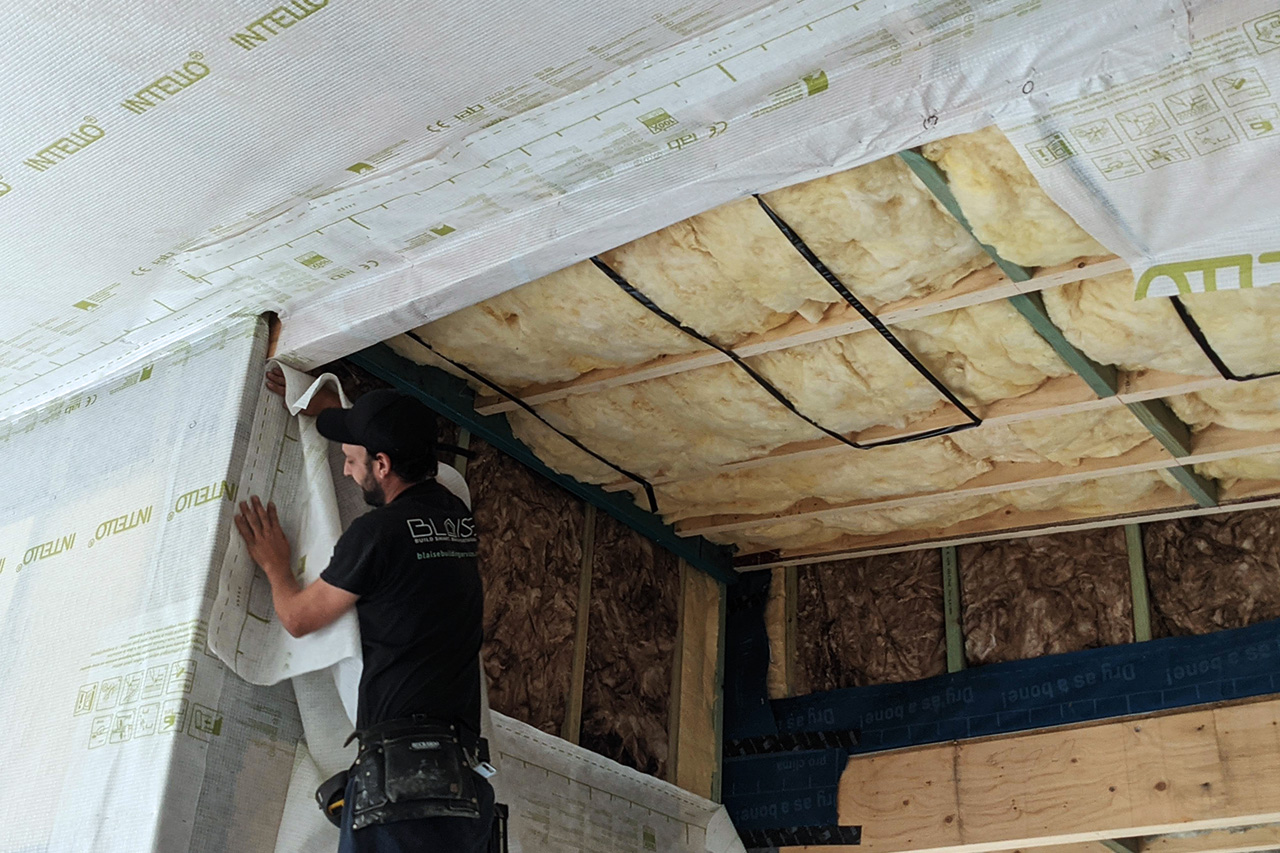
It is just as important to have a quality installation as it is to use high-quality materials. Only by properly installing them can you avoid air leaks and moisture entry into the building envelope, both of which can lead to mould growth and structural damage.
A blower door test uses a fan and pressure measurement to assess air leakage through the building envelope. The reported air changes per hour must be read with the test pressure and method. A lower result indicates less leakage under those test conditions; it does not measure every aspect of energy use or indoor air quality.
Airtightness needs planned ventilation. Sealing unintended leaks should work alongside a designed fresh-air system and moisture control. Our Seaforth project publishes a 0.9 ACH result and explains that the home follows Passive House principles without formal certification.
For existing homes, read about EnerPHit renovation and building-envelope upgrades. The scope depends on which junctions and existing elements can be improved. A blower door result alone should never be presented as whole-building certification.
An airtight building envelope is important for more than just preventing mould damage. Buildings that are airtight create a comfortable living environment, protect the environment, and save money on energy. As a result, they protect the structure, the people's health, and their money all at the same time.
When designing the airtight building envelope, we make sure to select materials that are free of harmful pollutants to ensure that nothing compromises the thermal performance of the structure.
If you would like to find out more about Passive House, get in contact with us.

Stephane Blaise
Director, Blaise Building Services
Class 2 Practitioner Builder — a higher tier of licensing than a standard Licensed Builder. Certified Passive House Tradesperson and Certified Passivhaus Designer (Passivhaus Institut, Germany). Member, Master Builders Association NSW and Australian Passive House Association.